Esteban, Andrés, Daniela, Paulina, stefany, Hugo.
jueves, 18 de febrero de 2016

WebQuest for the Classroom by Blake Day. Daniela,Paulina,Stefanny,Hugo,Esteban,Mateo,Andrés.
Educational
technology :
- There are many different methods, strategies,
and software programmes that are meaningful for communication, in which
students are engaged in the use of technology in a good way.
- this tool is important for students and for
teachers because it allows to improve and make easier teaching learning
process.
WEBQUEST.
- Is an Educational program that helps to
develop critical Thinking , cooperative learning,authentic assessment, and
technology integration.
- The webquest makes students to be involved in
researching a problem /question.
Title Page
- This page starts the WebQuest, titled
Industrial Revolution WebQuest. Each item on this page should be one or
two words to give a summary of what the page will be. The page also include
graphics or pictures, representing elements of the WebQuest.
- The
Industrial Revolution marks a turning point in history, changing and
influencing all aspects of daily life in one way or another . Both
agricultural production and the nascent industry multiplied while
decreasing production time, also this revolution included new technologies
and methods to improve the productivity.
Task
- A short concise explanation of the events is
taking place during the Industrial Revolution and the product a student must
produce. For this mission , the students
will be the leading researchers in the social conditions of life of Great
Britain.
Process
- The process splits the variety of detailed
task that the students are to accomplish. For example: Working conditions of children.
The Production of
Products
- The production of products includes:
- An essay which provides findings a
recommendations.
- A presentation showing conditions and
recommendations for change.
Sites to review and research.
- The web sites in where students find and
resource information should be sites approved, for example databases,
thesis grades, investigations and articles.
- The information should be divided in
hyperlinks according with the topic, date or lesson.
Evaluation and
Conclusion
- For evaluation and conclusion the use of
rubrics is recommended, for the students, in order to allow them be clear
about what they did well or not, and which aspects they need to improve.
Teacher's page.
the teacher’s page is a summary of remarkable topics of real world
feedback, from people outside the classroom, in order to have relevant material
for students to develop their critical skills.
Examples of suggested criteria for students, are as follows:
Subject: History
. Analyze reasons (why england was the first country to industrialize)
. Examine how (scientific and technological changes bla bla bla…)
. Discuss the important inventions ….
. Describe the growth of cities …
. Describe the changes and work ….
. Describe the effects of …
and so on…
English language arts
.
- writing
strategies
- writing
applications
- Write
expository compositions.
- write
persuasive compositions.
- Use different semiotics modes for make an
appropriate presentation.
- Deliver
persuasive arguments
- Deliver
descriptive presentation
National technology foundation standards for
students.
-Basic operations and concepts. (The students should have an idea of how
to use technology)
-Social ethical and human issues. (Students manage technology very
responsibly)
-Technology productivity tools (Technology allows for more effective
learning)
-Technology communications tools (students communicate ideas through
multiple media)
-Technology research tools (Allow for the search of new sources, plus
the possibility of reporting results)
-Technology problem solving and decision making tools (Students apply
technology to solve issues in the real life context)
Credits Page
Here you credit the sources for information, images and the like, in the
case of Day’s article, Dodge and Rubistar are to be credited.
WHAT IS A WEBQUEST?
- A WEBQUEST is a tool for learners so they do
not waste time looking for information that might be not useful. They have
to use the information the teacher puts on the WebQuest in order to help
students to learn something new.
- It is a didactic way to allow students to
learn how to access effectively to technology through implemented
activities that demand researching in which students construct their
knowledge by themselves.
- It is a powerful tool for learning. It
provides students various tasks designed to motivate them. It allows them
to create, make, something they are proud of and because of this, they are
left with something, even after the task is done.


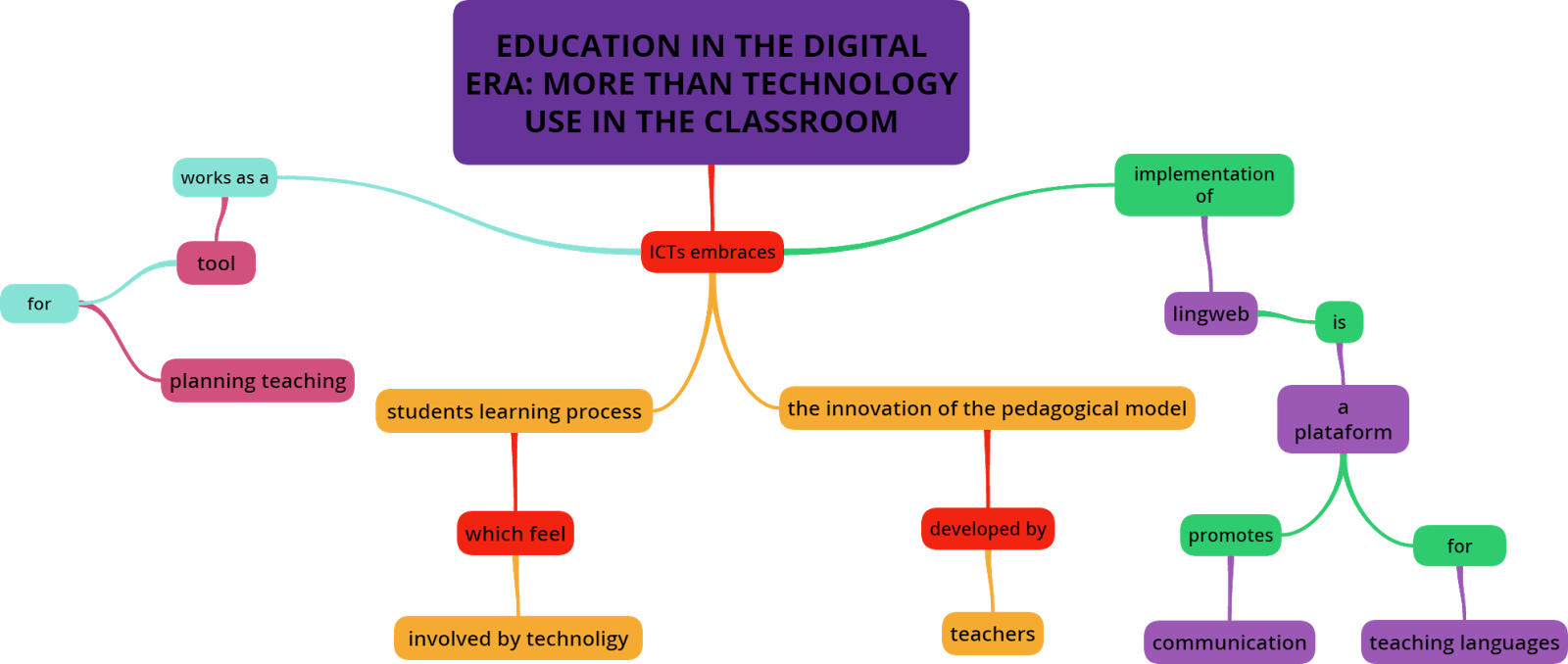
Education in the digital era, a report of it by Esteban and Freddy
After talking during the class, we both came to some ideas which we are going to share today:
Teaching with ICT can be tricky, as one could leave behind some competences in favor of others.
Plus, it is very obvious that technology opens new path as it allows one to use never seen before tools.
However, if teachers use the same teaching software in the same way all over again, there won't be innovation.
Now the best scenarios for teaching are ones in which...
-there si exposure to language
-there is exposure to what the learner wants
-there are opportunities to interact with language
-the learner can receive assesment from others and can make self-assesment
The ideal way to teach would be to merge as many of these as possible, and using technology to appeal students would make it even better.
Teachers should develop their method to be both creative and effective.
Teaching with ICT can be tricky, as one could leave behind some competences in favor of others.
Plus, it is very obvious that technology opens new path as it allows one to use never seen before tools.
However, if teachers use the same teaching software in the same way all over again, there won't be innovation.
Now the best scenarios for teaching are ones in which...
-there si exposure to language
-there is exposure to what the learner wants
-there are opportunities to interact with language
-the learner can receive assesment from others and can make self-assesment
The ideal way to teach would be to merge as many of these as possible, and using technology to appeal students would make it even better.
Teachers should develop their method to be both creative and effective.

miércoles, 17 de febrero de 2016

Written about the first two videos about webquest BY: Paulina Alvarez, Mateo Benavides
For
students it is a great challenge, educate hand of technology why? Because it is
challenging, it is something new, today's business world make use of the
technology because already part of their lives, if business and money are such
an important area why education can´t access also this mean? , Using for
example the internet (Wi-Fi), using different desktop computers that provide
ease and comfort to a student learning English or any area.
The world
of media and entertainment, are also part of education and it is important to
learn more about it, in what way? Creating web pages that will help us as a
means of information, the blogs, the web quest, and the media that serves as a
means of participation and that student’s don´t get bored or lazy study any
area, or for example English.


martes, 16 de febrero de 2016


martes, 9 de febrero de 2016
WebQuest for the Classroom by Blake Day
Educational technology :
WEBQUEST.
Title Page
Task
Process
The Production of Products
Evaluation and Conclusion
Teacher's page.
The teacher’s page is a summary of remarkable topics of real world feedback, from people outside the classroom, in order to have relevant material for students to develop their critical skills.
Examples of suggested criteria for students, are as follows:
Subject: History
. Analyze reasons (why england was the first country to industrialize)
. Examine how (scientific and technological changes bla bla bla…)
. Discuss the important inventions ….
. Describe the growth of cities …
. Describe the changes and work ….
. Describe the effects of …
and so on…
English language arts .
Credits Page
Here you credit the sources for information, images and the like, in the case of Day’s article, Dodge and Rubistar are to be credited.
- There are many different methods, strategies, and software programmes that are meaningful for communication, in which students are engaged in the use of technology in a good way.
- This tool is important for students and for teachers because it allows to improve and make easier teaching learning process.
WEBQUEST.
- It is an Educational program that helps to develop critical Thinking , cooperative learning,authentic assessment, and technology integration.
- The webquest makes students to be involved in researching a problem /question.
Title Page
- This page starts the WebQuest, titled Industrial Revolution WebQuest. Each item on this page should be one or two words to give a summary of what the page will be. The page also include graphics or pictures, representing elements of the WebQuest.
- The Industrial Revolution marks a turning point in history, changing and influencing all aspects of daily life in one way or another . Both agricultural production and the nascent industry multiplied while decreasing production time, also this revolution included new technologies and methods to improve the productivity.
Task
- A short concise explanation of the events is taking place during the Industrial Revolution and the product a student must produce. For this mission , the students will be the leading researchers in the social conditions of life of Great Britain.
Process
- The process splits the variety of detailed task that the students are to accomplish. For example: Working conditions of children.
The Production of Products
- An essay which provides findings a recommendations.
- A presentation showing conditions and recommendations for change.
- The web sites in where students find and resource information should be sites approved, for example databases, thesis grades, investigations and articles.
- The information should be divided in hyperlinks according with the topic, date or lesson.
Evaluation and Conclusion
- For evaluation and conclusion the use of rubrics is recommended, for the students, in order to allow them be clear about what they did well or not, and which aspects they need to improve.
Teacher's page.
The teacher’s page is a summary of remarkable topics of real world feedback, from people outside the classroom, in order to have relevant material for students to develop their critical skills.
Examples of suggested criteria for students, are as follows:
Subject: History
. Analyze reasons (why england was the first country to industrialize)
. Examine how (scientific and technological changes bla bla bla…)
. Discuss the important inventions ….
. Describe the growth of cities …
. Describe the changes and work ….
. Describe the effects of …
and so on…
English language arts .
- writing strategies
- writing applications
- Write expository compositions.
- write persuasive compositions.
- Use different semiotics modes for make an appropriate presentation.
- Deliver persuasive arguments
- Deliver descriptive presentation
- Basic operations and concepts. (The students should have an idea of how to use technology)
- Social ethical and human issues. (Students manage technology very responsibly)
- Technology productivity tools (Technology allows for more effective learning)
- Technology communications tools (students communicate ideas through multiple media)
- Technology research tools (Allow for the search of new sources, plus the possibility of reporting results)
- Technology problem solving and decision making tools (Students apply technology to solve issues in the real life context)
Credits Page
Here you credit the sources for information, images and the like, in the case of Day’s article, Dodge and Rubistar are to be credited.
WHAT IS A WEBQUEST?
- A WEBQUEST is a tool for learners so they do not waste time looking for information that might be not useful. They have to use the information the teacher puts on the WebQuest in order to help students to learn something new.
- It is a didactic way to allow students to learn how to access effectively to technology through implemented activities that demand researching in which students construct their knowledge by themselves.
- It is a powerful tool for learning. It provides students various tasks designed to motivate them. It allows them to create, make, something they are proud of and because of this, they are left with something, even after the task is done.
miércoles, 3 de febrero de 2016
Reconceptualizing and Recontextualizing Webquests.
Sanford, J., Townsend-Rocchiccioli, J., Trimm, D., & Jacobs, M. (2010). The webquest: Constructing creative learning. The Journal of Continuing Education in Nursing, 41(10), 473-479.
Based on the nurses' experience using WebQuests for learning purposes, how could we as future teachers replicate this successful action when planning our own lessons?
Sviridon, R. (2008). WEBQUEST AS AN EFFECTIVE TASK-BASED ACTIVITY IN THE ENGLISH LANGUAGE COURSE. АНГЛИЙСКИЙ ДЛЯ ЧЕЛОВЕКА ХХI ВЕКА: ВЛАДЕНИЕ АНГЛИЙСКИМ ЯЗЫКОМ КАК ЗАЛОГ УСПЕШНОСТИ НА РЫНКЕ ТРУДА, 107.
Sviridon, R. (2008). WEBQUEST AS AN EFFECTIVE TASK-BASED ACTIVITY IN THE ENGLISH LANGUAGE COURSE. АНГЛИЙСКИЙ ДЛЯ ЧЕЛОВЕКА ХХI ВЕКА: ВЛАДЕНИЕ АНГЛИЙСКИМ ЯЗЫКОМ КАК ЗАЛОГ УСПЕШНОСТИ НА РЫНКЕ ТРУДА, 107.
Why have WebQuests become a preferred tool for class planning nowadays?
jueves, 28 de enero de 2016
Week 2 (Jan. 26-28) – What are WebQuests I: (Re-)Introducing the Term
Since we’re back to work on WebQuests, it is important to revisit what they are. This will be our work for this week.
To get us started, I want you to watch these two videos. One featured the WebQuest master himself, Dr. Bernie Dodge:
Also, watch this video where a group of gifted students in 1st and 2nd
grade talk about WebQuests
This second video is
particularly interesting as it goes on to prove that WebQuests as a learning
tool don’t really have a ceiling. All ages and language competence levels have
the potential to create top-notch WebQuests.
As you watch this, in class you are going to come up with a brief working definition of WebQuests.
miércoles, 27 de enero de 2016
Reconceptualizing and Recontextualizing Language Education and ICTs in the Classroom – An afterthought
As you watch Prof. Areiza Lecture last week, think about the central transformation that lecture is calling for in the way we should conceive language teaching today. Complement this discussion with the new challenges for ICT and language learning posed in the three articles below:
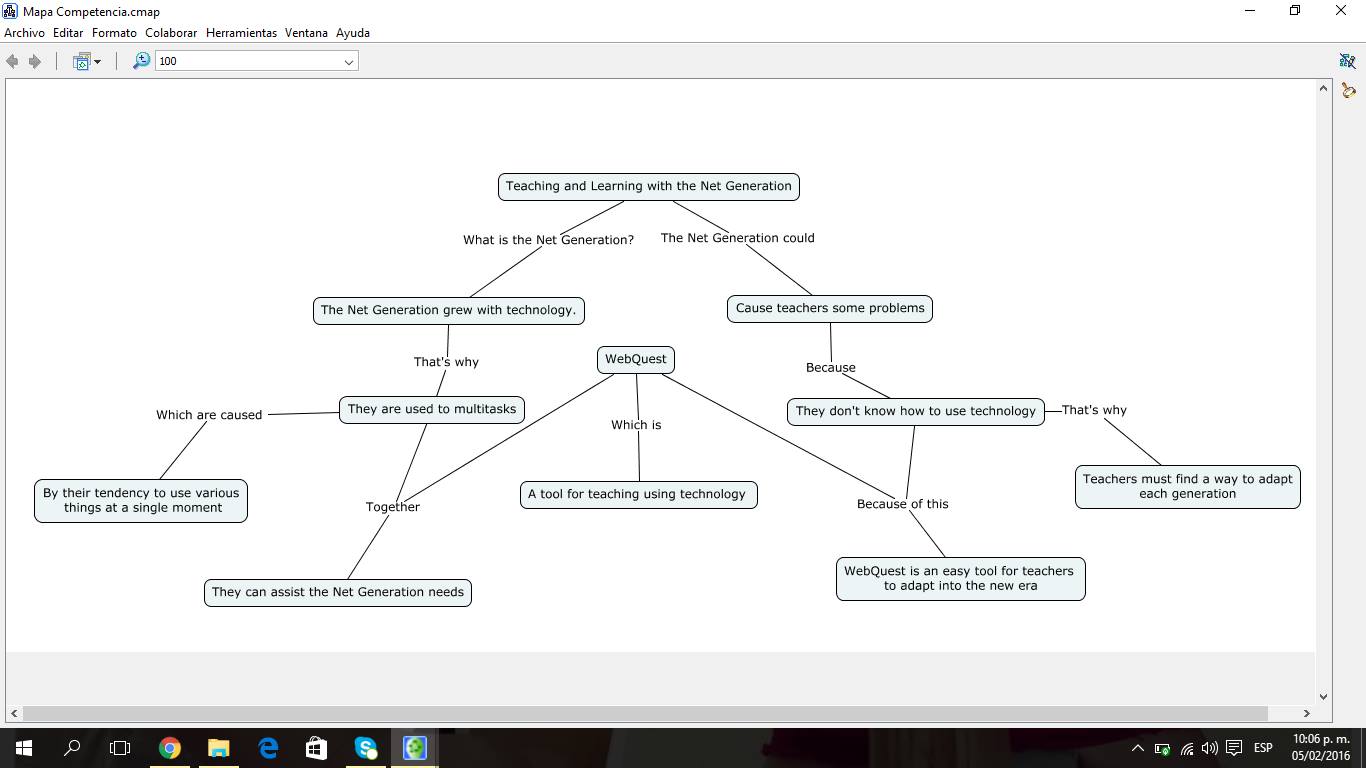
Barnes, K., Marateo, R., & Ferris, S. (2007). Teaching and learning with the net generation. Innovate, 3(4). Retrieved from http://uruguayeduca.edu.uy/Userfiles/P0001/File/Teaching_and_Learning_with_the_Net_Generation.pdf
Please post here your mind maps and comments regarding Barnes, K., Marateo, R., & Ferris, S. (2007) reading.
Mora R. A. (2011, August). Challenges and Opportunities for Literacy and Technology in ELT Teacher Education. Keynote Presentation at the 2nd Colloquia on Research and Innovation in Foreign Language Education 2011, Bogotá D.C., Colombia. Retrieved from http://files.eric.ed.gov/fulltext/ED547648.pdf
How could we as preservice teachers adapt education to our students' needs nowadays bearing in mind the characteristic of obiquitous learning, in a world everytime more multimodal?
Mora, R. (2014a).
Technology, digital literacies, and language ecologies. Rethinking the
intersection between technology, digitalliteracies and Language Ecologies.
Enletawa Journal (7), pages 115-128. https://www.academia.edu/13823015/Rethinking_the_intersection_between_technology_digital_literacies_and_language_ecologies
How has a language user been influenced by the implementation of ICTs?
Suscribirse a:
Entradas (Atom)